

With social media filters and rapid trend cycles, misinformation regarding plastic surgery spreads faster than facts. As a facial cosmetic surgeon practicing in DUMBO, Brooklyn, I frequently meet patients who have researched rhinoplasty for years yet still hold onto misconceptions that could jeopardize their reasoning and understanding of this popular procedure. They arrive with ideas rooted in digital myths rather than physiological reality.
Rhinoplasty is perhaps the most complex procedure in cosmetic surgery because it marries strict architectural function with artistic nuance. It requires a profound understanding of how cartilage, bone, and skin interact. Not just immediately after surgery, but for decades to come. To make an empowered decision about your appearance, we must first separate internet fiction from anatomical fact. Here are the five most common myths I encounter in my practice, and the realities you need to understand.
Many patients arrive with photos of noses they like and hope those features can be recreated on their own face. While inspiration images can be helpful, rhinoplasty does not work by copying one nose and placing it onto another person.
Every rhinoplasty is constrained and guided by the patient’s starting anatomy. The size and shape of the existing bone and cartilage framework, along with the thickness and quality of the skin, determine what is realistically achievable.
Rhinoplasty is surgery on bone and cartilage, not on skin. The skin itself is not removed or tightened in any meaningful way. If a nose began with a larger framework, it developed a proportional amount of skin to cover it. That skin does not automatically contract to fit a dramatically smaller structure.
I often explain this using a simple clothing analogy. You cannot reasonably take a nose from a size large to an extra small. In most cases, moving up or down one size, sometimes one and a half, allows the skin to drape naturally and predictably. When the framework is made too small for the skin envelope, especially in patients with thicker skin, the result can look soft, undefined, or structurally weak rather than refined.
This is why rhinoplasty must be evaluated in the context of the entire face. Forehead shape, lip projection, chin position, jaw strength, and overall facial proportions all influence what looks balanced. Will an extra small nose even look right on an individual patient? A nose that looks elegant on one person may feel out of place on another. It’s important to remember that we are not creating a beautiful nose in isolation, but rather one that sits with and connects to the rest of the face.
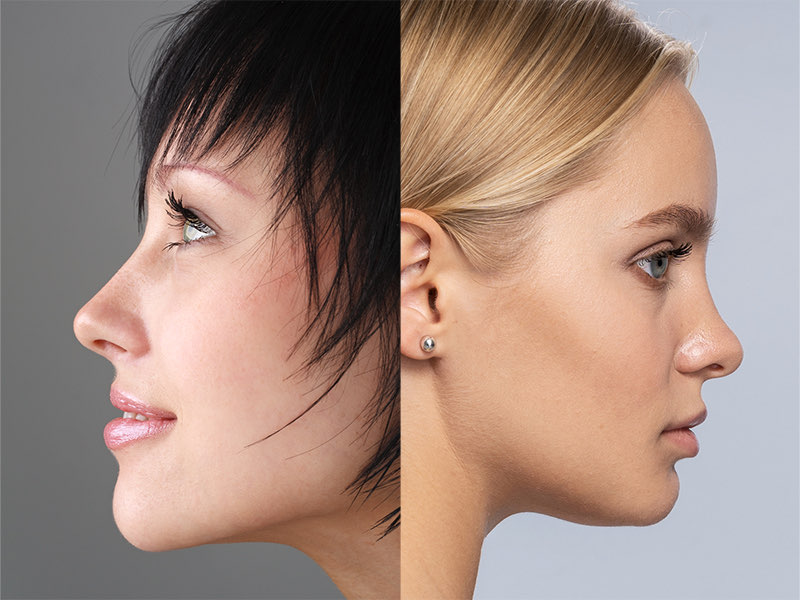
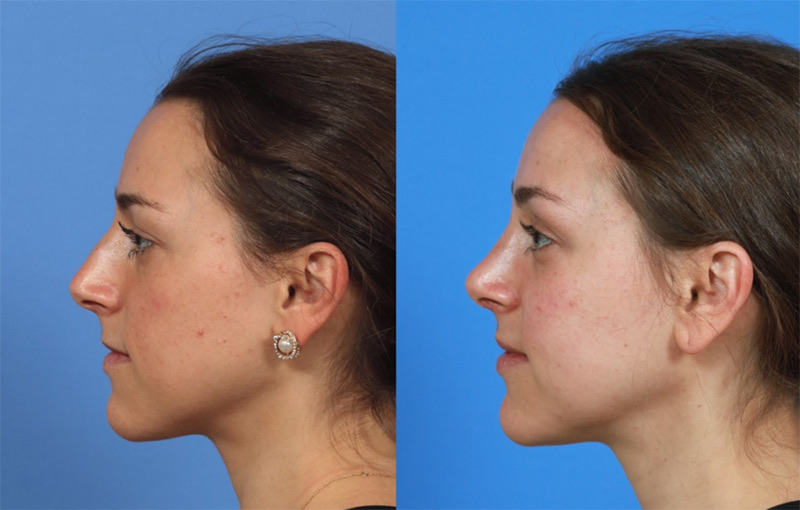
These are not my patients, but these images illustrate two attractive women with very different nose-to-chin proportions, nasal shapes, and aesthetic possibilities. Using someone else’s photo as a “wish pic” does not always translate to what is possible for you. The nose is not a solid structure; it contains air and empty space. As surgeons, we do not simply “chop down” parts. During surgery, elements are carefully rearranged, and yes - sometimes reduced in size - but they are also strengthened and reinforced before finishing.
Many patients worry that open rhinoplasty will leave a visible scar at the base of the nose. In over a decade of practice, I have rarely seen a patient request revision of the columellar incision, and when they have, it is almost always a minor laser procedure to smooth a faint line.
The incision is placed on the columella, the narrow strip of skin between the nostrils, and is typically just a few millimeters long. When closed with meticulous technique, it heals extremely well and becomes nearly imperceptible. Any visible irregularities are more likely related to the shape and structure of the underlying cartilage than to the skin incision itself.
Some patients are drawn to closed rhinoplasty approaches to avoid even this tiny scar. While closed techniques can be appropriate in select cases, the open approach allows me to see the nasal anatomy fully and work with precision, making complex adjustments safer and more predictable. For me, the benefit of complete visualization outweighs the minimal risk of a faint, well-placed incision.
Ultimately, the goal is to create a nose that functions, breathes, and looks natural. The tiny columellar incision is a small trade-off for a result that is stable, refined, and built to last.
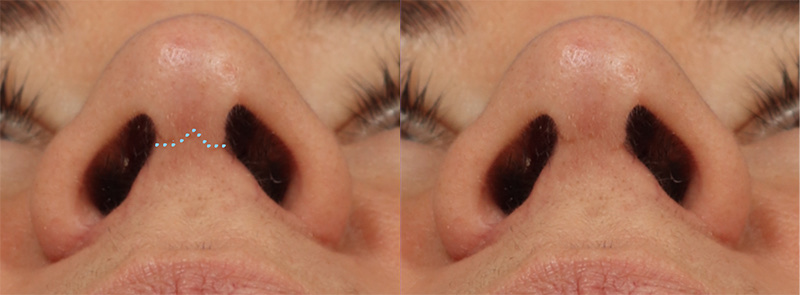
Example of a healed trans-columellar incision in one of my patients, at three months after surgery. On the left, you can see approximately where the incision was made and the typical shape of a classic trans-columellar incision in open rhinoplasty. The line is very faint, visible only in high-resolution photography or under certain lighting. This incision was not treated with laser, and in most cases, it is not necessary to do so. For up to 12 months, this incision fades, flattens, and becomes largely impercetible.
Computer imaging is one of the most common misconceptions patients have about rhinoplasty. Many people assume that if they see a simulation of their nose, that is exactly what it will look like after surgery. In reality, imaging is a communication tool, not an exact mirror. I use it to make sure we are aligned on aesthetic goals and to demonstrate the direction of our work, but it is not a guarantee of the final result.
During a consultation, I show imaging to explore preferences like the degree of tip rotation, the straightness or curvature of the profile, and how much refinement a patient wants in the bridge. It helps create a shared visual language between surgeon and patient, especially when words alone are insufficient. I often tell patients to think of it as a “wish pic of yourself”.
What imaging cannot account for is biology. It cannot predict how your skin and soft tissue will adapt to changes in the underlying framework. Swelling and scar tissue formation vary from person to person, and the nose behaves as a living, dynamic structure during surgery. Unlike carving marble or wood, we are working on bone and cartilage covered with soft tissue that responds differently in every patient. An exact replication of the simulation is not realistic, and no ethical surgeon would promise that level of precision.
Imaging also guides me artistically during surgery. When the tissues are swollen, I reference the simulation to help visualize proportions, but adjustments must be made in real time based on the anatomy at hand. An experienced surgeon knows how to anticipate how the nose will settle, taking into account the thickness of the skin, the elasticity of tissue, and how gravity affects swelling over time. This is the skilled part of the surgery.
The key takeaway is that imaging is an invaluable tool for communication and planning with a facial cosmetic surgeon in New York, but it is not an exact blueprint. Patients who expect perfect alignment with the simulation often set themselves up for disappointment. The goal is to use imaging to guide decisions, refine goals, and create realistic expectations, while respecting the limitations and individuality of each patient’s anatomy.
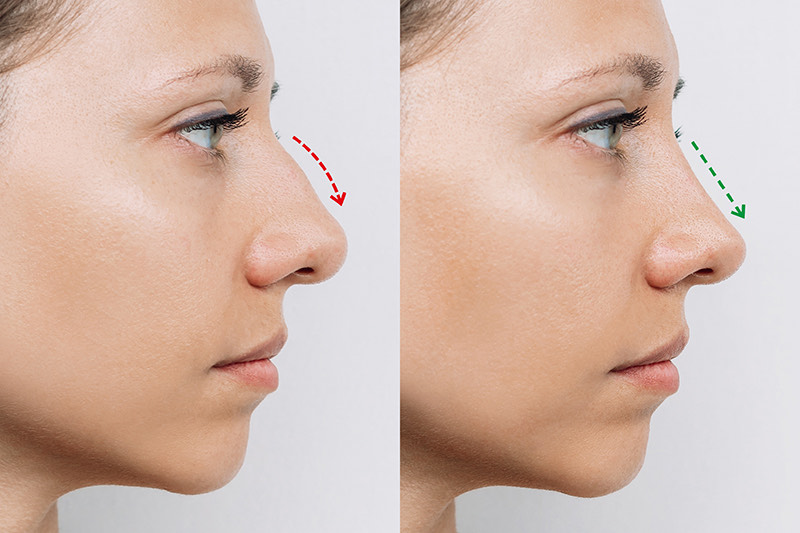
Computer simulation is a way to envision your own nose and explore the changes that are anatomically possible under your surgeon’s guidance. These reference images are available during surgery to help guide decisions in real time, but they are not overlaid on your actual tissues and cannot ensure millimeter-level accuracy. The final nose is intended to reflect a similar style and shape, but exact replicas cannot be guaranteed.
Many patients think that if they are seeking rhinoplasty purely for cosmetic reasons, the internal structures like the septum are irrelevant. They see websites that list rhinoplasty and septoplasty as separate procedures and assume functionality and aesthetics can be treated independently. They wonder why a surgeon would even touch the septum if they breathe fine.
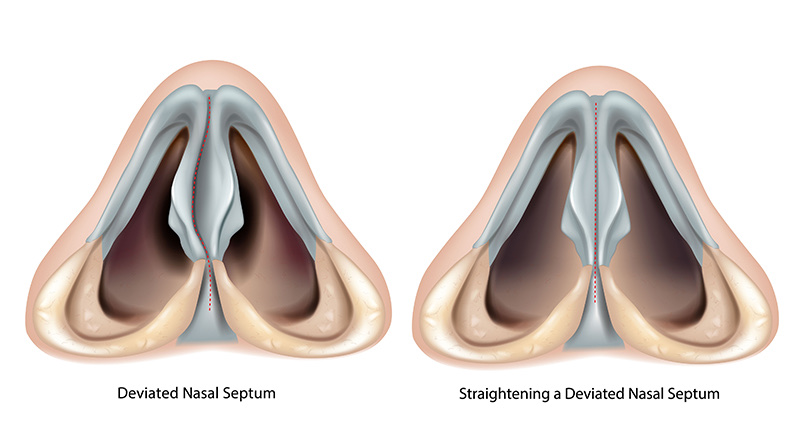
This base view shows the septum, the partition between the left and right nostrils. The inside connects with the outside, so crookedness internally affects the external nose. Even if it isn’t obvious from the base, it can be seen deeper inside during surgery. In most cases, a rhinoplasty is almost always a septorhinoplasty, not just to correct crookedness, but also to harvest natural cartilage for reshaping and cosmetic changes.
This is one of the biggest misconceptions about rhinoplasty. The external nose—the part you see—is completely connected to the internal framework that controls airflow. I often explain this using a house analogy: the walls, roof, and floor are connected through beams and junctions. If the walls inside are crooked, would you want a perfectly straight roof built on top? Most people would not. The same principle applies to the nose. Ignoring the septum in cosmetic surgery may be technically possible, but it compromises both stability and long-term aesthetics.
Septal cartilage is not just for breathing. It is essential building material. During surgery, I often harvest septal cartilage to reshape and support the nasal tip and bridge. This cartilage is what allows me to slenderize a nose, rotate the tip, or reduce a dorsal hump while keeping the structure strong. Surgeons learned decades ago that discarding septal cartilage and reshaping the nose without internal support could lead to collapsed, pinched, or otherwise deformed results. This is why many celebrity noses failed on the public stage after poorly executed surgeries.
By addressing the septum, we are optimizing three things at once: function, aesthetics, and structural longevity. Even patients who do not recognize any breathing difficulty often discover a noticeable improvement in airflow after surgery. In my practice, every first-time rhinoplasty is a septorhinoplasty because separating these components would be doing a disservice to the patient and the result.
Many patients worry that rhinoplasty recovery is slow and that they will not see the benefits of their surgery for a full year. While it is true that the final tip definition can take months to fully settle, most of the improvement happens early in the healing process, and patients often notice dramatic changes within the first few weeks.
Roughly 80 percent of swelling resolves in the early part of recovery, while the remaining 20 percent gradually resolves over the rest of the year. This means that although the final tip refinement requires patience, the majority of the transformation is visible quickly, as shown in our rhinoplasty gallery, and patients often feel comfortable returning to work or social events within two to three weeks.
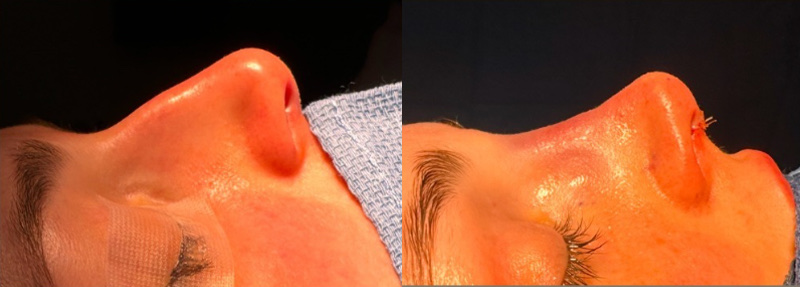
On-the-table results immediately after septorhinoplasty. Nasal refinement and dorsal hump reduction were performed. There is significant swelling of the nasal tip, bridge, lower forehead, and even the nasal sidewalls. This is often why the tip looks more “upturned” on the table, which is known to begging settling down in the first few weeks. It takes feeling the nose during this stage allows the surgeon to confidently shape it according to the imaging and the patient’s goals, despite the obvious swelling.
Initial swelling is most obvious immediately after cast removal at one week. Swelling is normal and expected, and it can vary from person to person depending on the complexity of the surgery, skin thickness, and how much bleeding occurred. Bruising generally fades by the end of the second week, allowing most patients to go back to their daily activities without concern.
The tip is always the last part to fully refine, as gravity can trap residual swelling there. These final adjustments are subtle, but meaningful, and they allow the skin to adapt to the new framework. While patience is required, most patients are pleasantly surprised at how much change they see early on and feel confident enough to share their new profile long before the one-year mark.
Same patient as the example shown above, shown three months after septorhinoplasty surgery. By this point, most swelling has resolved, though small changes can continue over the remainder of the year, particularly in the nasal tip and the lower portion of the bridge.
Rhinoplasty, or now that we have reviewed Myth #4, Septorhinoplasty, is a permanent surgical alteration to the central feature of your face. You may have read, heard, or watched videos where surgeons admit that rhinoplasty is one of the most challenging operations of the face. I would largely agree with this, even as a surgeon who loves the surgery and finds it incredibly gratifying. Just as patients spend time finding and choosing the right surgeon for their needs, I too spend my consultation time exploring each patient’s wishes and whether I can safely and predictably achieve them. There is no “cosmetic” emergency, and both patient and surgeon must find one another to take the next step together, with alignment in vision and a healthy understanding of the goals versus limitations.
If you are ready to let go of permeating myths and receive a candid, anatomy-led assessment of what is possible for your profile, I invite you to schedule a consultation with a rhinoplasty surgeon whose results you have come to appreciate. And of course, maintain an open mind during the consultation and imaging to see if their vision matches your excitement for change.
As always – thanks for reading.
xo, Dr. Renata
Medical disclaimer: The results and experiences shared in this blog, where indicated in writing, reflect real patient outcomes from procedures I have personally performed. They are intended for educational and informational purposes only and should not be interpreted as medical advice or a guarantee of results. Cosmetic surgery outcomes vary based on individual anatomy, healing response, and other personal factors. Every surgical procedure is both a science and an art, and results will differ from person to person. For personalized medical guidance, please consult with a qualified and board-certified healthcare provider.
At RENATA Facial Cosmetic Surgery, we prioritize privacy. While many Before & After photos are featured on our website and social media channels, we understand not everyone wishes to share them publicly. To respect our patients’ unique preferences, we invite you to explore a more comprehensive Before & After gallery during your consultation in our office.
Life can be demanding, and we understand. For patients who may be traveling, preparing for a last-minute occasion, or simply looking for a more exclusive experience without any inconvenience or delays, we are pleased to offer preferred patient scheduling. Patients may undergo a personal consultation as well as tailored cosmetic treatments during evening hours or weekends. Appointments are required and premium rates apply. Please call our office to inquire about preferred patient scheduling and allow us to create an exceptional experience just for you.
Contact UsAt RENATA Facial Cosmetic Surgery, patients receive excellent customer service, communication, personal attention, and scheduling flexibility. Located in the historical and breathtaking waterfront neighborhood of DUMBO, Brooklyn in New York City, our office serves local neighborhoods including Brooklyn Heights, Park Slope, Williamsburg, and Cobble Hill, as well as Manhattan and New York City at large.
Our office location is:
58 Prospect Street, Brooklyn, NY 11201
Monday - Friday: 8:30AM to 4:30PM Saturday (by appointment only): 9:30 to 2:30PM