

Over the past decade, dermal fillers have become closely tied to the conversation about surgery. I routinely meet patients who have been told that filler can “lift” the cheeks, the jowls, or the lips in a quick office treatment. Many patients come to see me after pursuing this path. They received filler, but did not experience the lift they were hoping for.
Fillers have an important and legitimate role in aesthetic medicine. But volume and lifting are not the same thing.
Before I recommend any surgical intervention, I evaluate the entire face, not simply a wrinkle or one isolated area. I assess skeletal proportions, the position of facial fat compartments, skin quality, and the cumulative effects of prior aesthetic treatments.
A consultation often involves separating the natural changes of aging from the changes created by repeated injectables. Many patients are surprised to learn that prior fillers may also influence their ability to achieve the best surgical outcome. When surgery is delayed through repeated attempts at volumization, the tissues continue to descend while additional volume is layered on top.

Fillers come in different varieties and are composed of different materials. The majority of fillers on the market are made of reversible hyaluronic acid. There are also biostimulatory fillers, which work by stimulating the body’s inflammatory and healing responses to promote collagen production over time.
A very well-known facial plastic surgeon once said to me in the operating room, “Volume is overrated.” At the time, he was lifting the midface and neck of a 68-year-old woman with severe skin laxity. As I watched him reposition the tissues, the statement made sense. It makes even more sense to me today, after performing thousands of facial filler treatments.
Facial aging is a multi-layered process. Over time, bone resorbs. Ligaments weaken. Fat compartments descend under the constant pull of gravity.
What we see clinically is not simply volume loss. It is a change in position and structural support across the entire face.
A surgical procedure such as a deep plane facelift addresses multiple layers at once. Key attachments are released, and the tissues are repositioned higher and back toward their original anatomy. Skin, fat, muscle, and connective tissue move together as a single unit.
In many patients, no additional volume is added at all. The goal is not to create fullness. The goal is to reposition the fullness that already exists.
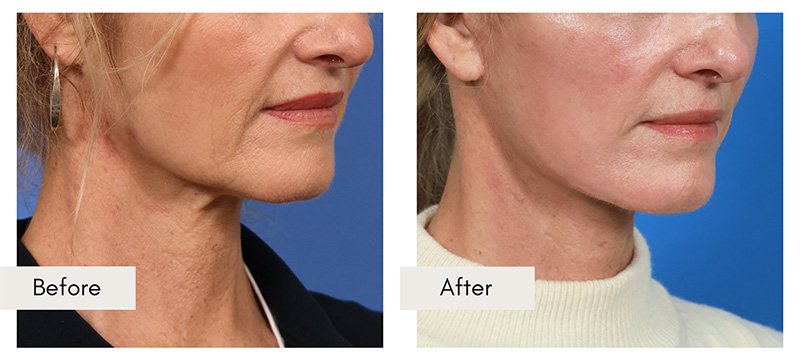
This beautiful patient came to me hoping to look refreshed, with particular concerns about skin laxity and aging of the neck. Because filler cannot meaningfully address laxity in this area, we focused on lifting and repositioning rather than adding volume. She underwent a deep plane face and neck lift with CO₂ laser resurfacing, and this result is shown about three months after surgery. The natural restoration of her facial and neck contours aligned beautifully with her goals.
Fillers do not change the underlying position of facial tissues relative to the skeleton. They add volume and tent the tissues outward.
Outward is not the same as upward.
Most temporary fillers are composed of hyaluronic acid, a hydrophilic molecule designed to attract and retain water. When used conservatively in areas of true volume deficiency, this can produce beautiful results.
However, the concept of a “liquid facelift” often relies on multiple syringes of filler to compensate for falling tissues. Treating tissue descent with volume is like trying to fix pants that are too big by gaining weight. You can bulk up to make them fit. Or you can tailor the pants to fit your body properly.
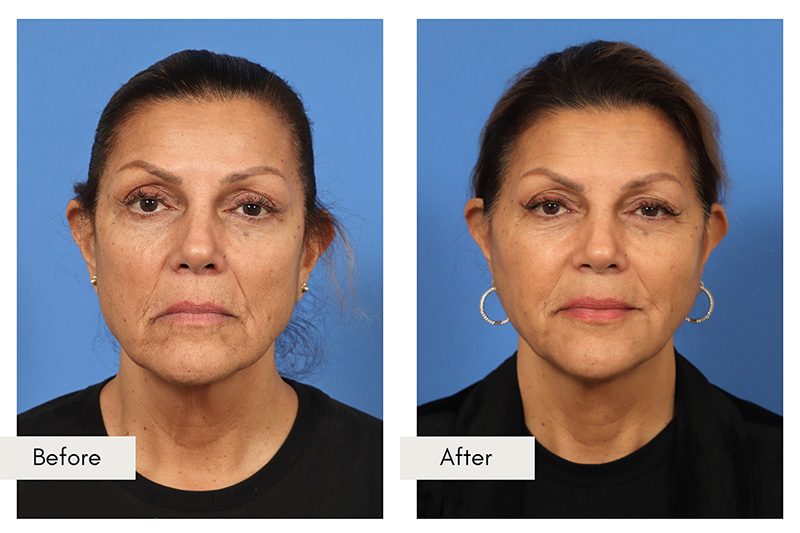
This is my beautiful patient who underwent treatment with hyaluronic acid–based filler to address generalized facial volume loss. Areas treated included the temples, cheeks, nasolabial folds, lips, chin, and jawline. Her goal was to restore a softer, more youthful, heart-shaped facial contour while softening volume-deficient lines. The result is a refreshed appearance that maintains natural balance without looking overfilled.
Unlike clothing, the face has proportions and aesthetic relationships that cannot simply be “filled in.” Excess volume can widen and burden facial features. It can also interfere with normal lymphatic drainage.
Distortion becomes most noticeable during facial expression. Multiple muscle groups move at the same time. Excess filler can shift, clump, and accumulate in unpredictable ways. The upper cheeks may have ridges when smiling. The jawline loses definition and becomes lumpy rather than crisp. The midface appears heavier, sometimes from the added water weight that hyaluronic acid attracts.
Over time, the natural skeletal framework becomes obscured beneath multiple gel-like layers. When this happens, even surgical evaluation becomes more complex.

Youthful facial volume is about optimizing the balance of light and shadow. Natural highlights accentuate the eyes, brows, and cheeks without creating distracting hollows or shadows. When done well, volume restoration recreates this balance and harmony, without overfilling.
The tension between injectables and surgery becomes most evident in areas that demand millimeter-level precision. In these regions, even small amounts of filler can distort anatomy and complicate surgical planning.
Lower Eyelids (Tear Trough)
The lower eyelid is a clear example. The skin in this region is the thinnest on the body, and lymphatic drainage is delicate.
Hyaluronic acid placed to camouflage tear trough deformity or early fat pooching frequently leads to persistent edema. The puffiness may fluctuate with hydration, sleep, or allergies, but it often remains present.
More importantly, retained filler distorts the true contour of the orbital fat pads. When evaluating a patient for lower blepharoplasty, I must determine the precise degree of fat herniation and lid support.
Surgical planning depends on understanding the patient’s true baseline anatomy. Filler creates an artificial baseline, making precise correction more difficult and less predictable.
Upper Lip (Lip Lift Planning)
A similar issue arises when planning a surgical lip lift.
Repeated lip filler treatments gradually expand the tissues of the upper lip, including the internal wet lip lining, the lip border, and the neighboring lip skin. Over time, the resting length of the upper lip adapts to this chronic volume expansion.
The lip may lengthen and descend under the weight of filler, creating what I often describe as a “shopping bag” effect.
A lip lift requires exact measurement of lip length, shape, and symmetry. When filler is present, this evaluation becomes unreliable. If those measurements are based on tissue that has been artificially and temporarily stretched, the postoperative result and healing dynamics become far less predictable.
While hyaluronic acid fillers mainly add volume, biostimulatory injectables work in a different way. These products stimulate the body to produce collagen by creating a mild inflammatory response in the tissues.
In aesthetic medicine this is often described as a regenerative process. From a surgical standpoint, however, repeated stimulation can lead to internal scar-like thickening (often termed fibrosis).
Cosmetic facial surgery relies on the ability to predictably separate the natural layers of the face. When tissues develop scar-like thickening, those layers may not glide as smoothly as expected. This can make the anatomy less clear and the surgical process more complex.
For this reason, I generally advise patients to avoid biostimulatory injectables if they are considering facial surgery within the next one to two years. Temporary aesthetic treatments are not intended to interfere with the tissue quality needed for the best possible surgical result.
None of this suggests that age-appropriate, FDA-approved fillers are inherently problematic.
When used conservatively and for their intended purpose, such as localized volume replacement in carefully selected patients, they can beautifully complement natural anatomy. Subtle cheek support, measured chin projection to balance the profile, or correction of a small amount of volume deficiency can often be achieved without compromising future surgical options.
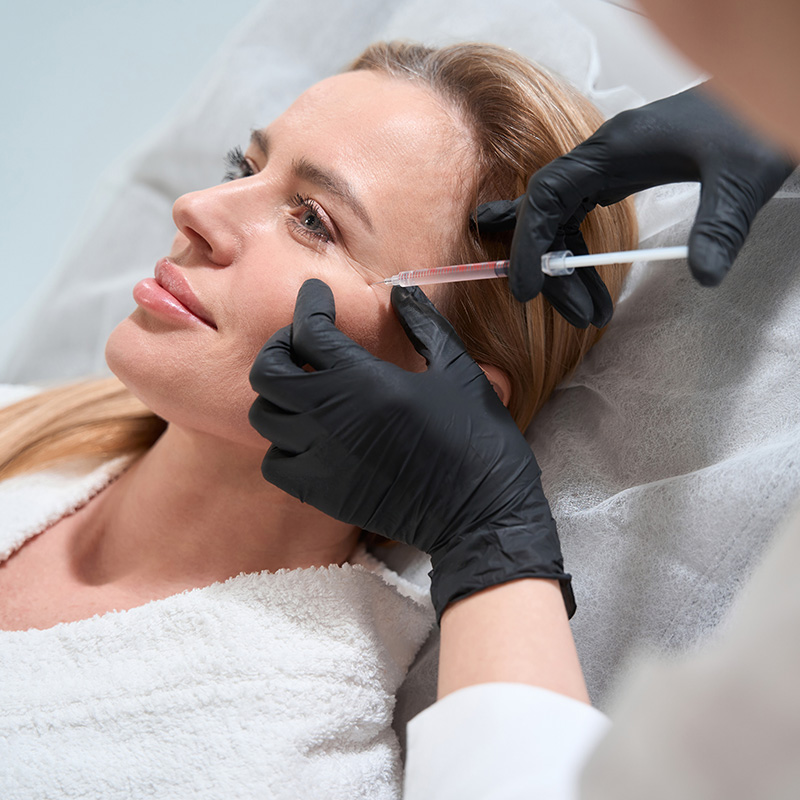
The difficulty arises when injectables are used, or overused, in an attempt to compensate for falling tissues and more advanced gravitational changes.
Volume cannot replicate suspension. When fillers are pushed beyond their intended purpose, they begin to compete with the natural anatomy rather than complement it.
For patients proceeding with facial surgery, my protocol is consistent.
Any hyaluronic acid filler placed within the operative field during the previous one to two years is dissolved prior to surgery. In certain areas, such as the lower eyelids and lips, I often recommend reversal even if the filler was placed many years earlier.
Hyaluronidase allows us to return the tissues closer to their baseline anatomy. Surgical planning is then based on the patient’s natural structure rather than retained puffiness.
If fillers are not reversed before surgery, the postoperative course can become more uneven and prolonged. I frequently observe greater swelling than what would typically be expected from surgery alone. Although many patients initially feel apprehensive about dissolving filler, they often come to appreciate that removing excess volume restores clarity to their features and allows for a more predictable healing process.
Aesthetic medicine works best when it respects anatomy.
Surgery and injectables are not adversaries, but they serve different roles. A surgical lift restores position. Fillers replace localized volume. When those distinctions are respected, each treatment can work exactly as intended.
Listening to your board-certified surgeon, and understanding their reasoning for surgery, injectables, or sometimes both, is the most reliable way to determine what is appropriate for your face and your stage in the aging process.
The goal is not simply to undergo treatments for the sake of doing them. I encourage patients to think instead about preserving facial proportions over time. When that principle guides decision-making, the face remains harmonious, and the treatments we use no longer compete with one another.
As always – thanks for reading.
xo, Dr. Renata
Medical disclaimer: The results and experiences shared in this blog reflect real patient outcomes from procedures I have personally performed. They are intended for educational and informational purposes only and should not be interpreted as medical advice or a guarantee of results. Cosmetic surgery outcomes vary based on individual anatomy, healing response, and other personal factors. Every surgical procedure is both a science and an art, and results will differ from person to person. For personalized medical guidance, please consult with a qualified and board-certified healthcare provider.
At RENATA Facial Cosmetic Surgery, we prioritize privacy. While many Before & After photos are featured on our website and social media channels, we understand not everyone wishes to share them publicly. To respect our patients’ unique preferences, we invite you to explore a more comprehensive Before & After gallery during your consultation in our office.
Life can be demanding, and we understand. For patients who may be traveling, preparing for a last-minute occasion, or simply looking for a more exclusive experience without any inconvenience or delays, we are pleased to offer preferred patient scheduling. Patients may undergo a personal consultation as well as tailored cosmetic treatments during evening hours or weekends. Appointments are required and premium rates apply. Please call our office to inquire about preferred patient scheduling and allow us to create an exceptional experience just for you.
Contact UsAt RENATA Facial Cosmetic Surgery, patients receive excellent customer service, communication, personal attention, and scheduling flexibility. Located in the historical and breathtaking waterfront neighborhood of DUMBO, Brooklyn in New York City, our office serves local neighborhoods including Brooklyn Heights, Park Slope, Williamsburg, and Cobble Hill, as well as Manhattan and New York City at large.
Our office location is:
58 Prospect Street, Brooklyn, NY 11201
Monday - Friday: 8:30AM to 4:30PM Saturday (by appointment only): 9:30 to 2:30PM